One sky, three shelves
The chart
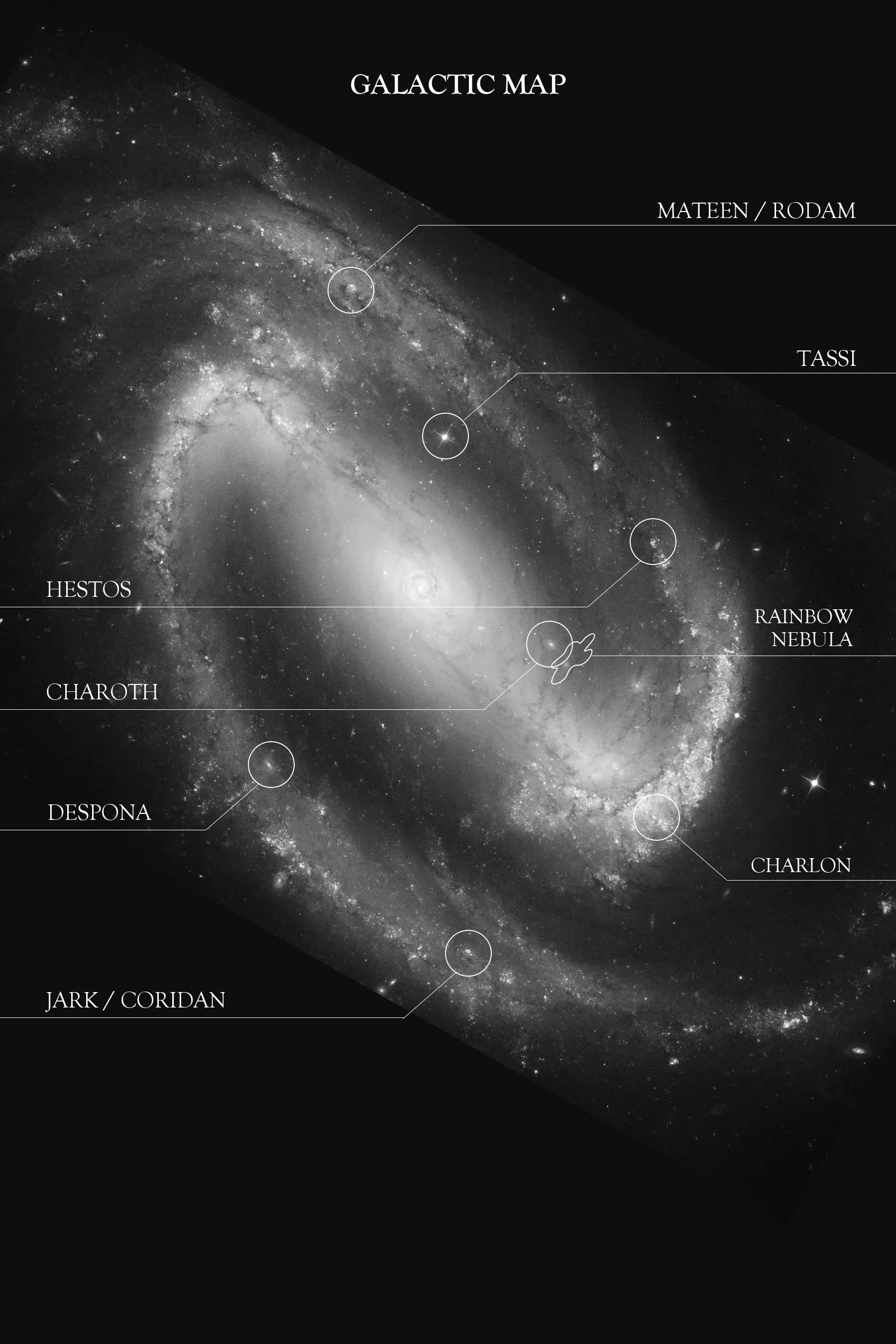
Every book here happens in the same galaxy. That is not a conceit — it falls out of one locked fact in the back of Rogue Fleet: Hestos is Sol. The Council chart renames our star and never mentions it. So Trials is the fourth planet of a system the space opera has been flying through the whole time, and Elpis is 12 light-years down the road from both.
Drag to pan · scroll to zoom · click a star to fall into it
What you are looking at
- Sol · Hestos
- One star, two names, and the hinge of the catalog. Trials is on the fourth planet. The Council chart of Rogue Fleet and Fractal Space calls the same star Hestos — "one star, eight worlds, a belt between the fourth and the fifth, and the third one blue."
- Corven
- An orange dwarf 12 light-years out, with Elpis in close orbit — the world of Ashfall, two moons, 1.15 g, and a biosphere built the wrong way round. Corven's light is why the Umber runs dark and amber.
- Council space
- Tassi, Jark, Mateen, Charoth, Despona and the Rainbow Nebula, spread across 1.8–6.8 kiloparsecs of arm. The plate is a galactic chart, and the one distance Rogue Fleet measures is framed as the small one — "a relatively small one, only fifty parsecs to travel." If fifty parsecs is a short hop, the chart is enormous.
What is measured and what is drawn. Corven's 12 light-years and Charlon's 50 parsecs are the numbers the books give. Everything else is arrangement: the drawn plate is schematic — Charlon appears a fifth of the way across it while the prose puts it next door — so its layout is honored and its spacing is not. No text gives a bearing, so directions here are drawn rather than claimed.
The systems, up close
- Tassi A binary system. The home world sits between two suns and is rarely out of their light — which is why rain on Tassi is rare, and torrential when it comes.
- Jark / Coridan Brokk's home world. Wretchedly hot, with a core so dense that its gravity shapes the bodies of everything living on it.
- Mateen / Rodam A collective of trillions whose presence can be felt across the void — their reassurance reaching a commander in space is a weight as much as a comfort.
- Charoth A planet of outlaws and vagrants, where a hunted fleet goes to be rebuilt and no question is asked twice.
- Hestos Our own system under another name — one star, eight worlds, a belt between the fourth and the fifth, and the third one blue.
- Charlon A moon, and a waypoint — measured against Hestos whenever anyone needs to explain a distance.
- Despona A world of green-skinned people, thick-bodied and rugged, and the place where a crew is taken.
The drawn plate
The chart above is built from this — the map printed in the back of Doomsayer. It stays here because it is the artefact, and everything above is an inference from it.